
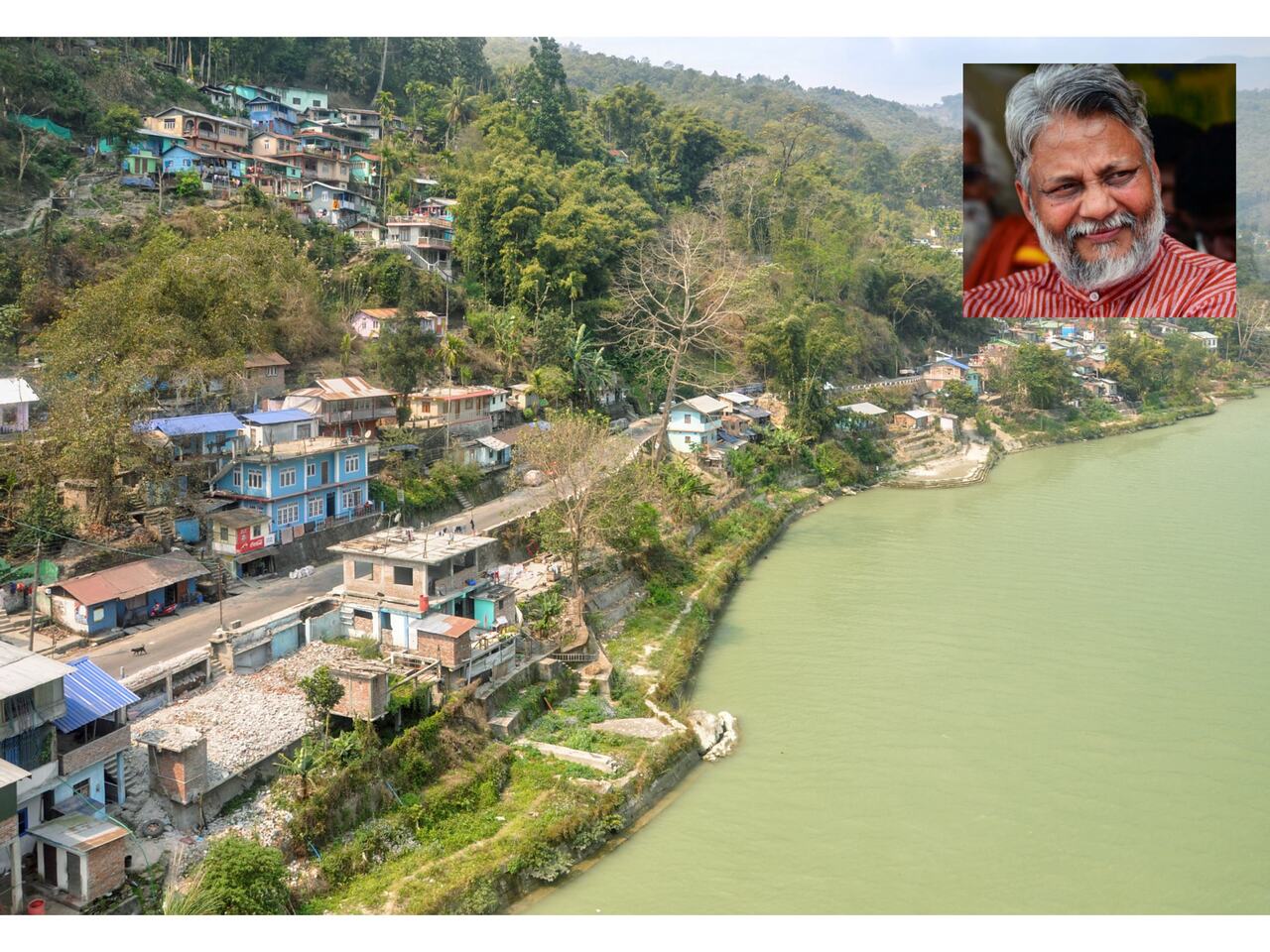

Another international river day – September 27, 2026 – another set of programmes and high pitch speeches on cards; but the rivers in India are dying and there is nothing unofficial about the claim A Central Pollution Control Board study recently found that out of the 623 rivers being assessed by them across India, around 271 rivers—about 43 percent – were polluted. The Plurals has spoken to river expert Rajendra Singh, a Magsaysay award and Stockholm Water Prize winner, widely hailed as the “Waterman of India”; to decipher what’s happening in India’s riverfront.
Jayanta Basu (JB): India, widely called a riverine country, has more than 40 percent rivers been significantly polluted according to an official study. On the other side, government’s own data shows that the union government has spent about Rs. 26,800 crores on rivers in last decade. How you explain this dichotomy; where is the money flowing?
Rajendra Singh (RS): The money is flowing with pollution! Just as there is pollution in our rivers, there is pollution in our mentality, and this money is flowing unused because of that pollution! A society and a government, those ensure that rivers remain as rivers; and not turned into drains, represent integrity. But in a country where rivers become drains because of pollution, I would say that there is a linkage between pollution and corruption. If we are spending so much money on pollution control and yet pollution is not stopping, in fact actually increasing, then, my dear friend, the data you have shared is actually a tip of the iceberg. My experience says that almost all the rivers in this country are polluted; you cannot find a single river whose water one can drink; most are unusable for even bathing!
JB: So many projects have been taken to rejuvenate Ganga and likewise. Several IITs prepared a joint prescription, and project, for the Ganga. But what is happening on ground?
RS: Look, the National Ganga River Basin Authority was formed in 2009. At that time, all the IITs in the country formed a consortium and studied the Ganga from its source to its confluence. The study diagnosed very well how the river could be restored. But the engineers turned that into an engineering report!
JB (interrupting):… You are saying that the IIT report was not handled properly or assessed in the right way. The work that should have been done based on that report was not carried out accordingly?
RS: Absolutely, it was not done. At that time, I was a member of the NGRBA. There were seven Cabinet Ministers in the Authority, along with several other experts. We tried hard to explore what needed to be done to restore the Ganga’s cultural, spiritual, social and natural character to its original self, what changes are required in society; what changes are required in the government actions on both sides of the river! All these were discussed in the Ganga Basin Authority.
But later, even meetings of the Ganga Basin Authority stopped taking place. In the last 12–14 years, as far as I have heard, perhaps a handful meetings were held of the authority. Money. spent in the name of the Ganga, end up in the pockets of contractors, and from the contractors’ pockets it goes into the pockets of politicians and engineers. It seems that the government wants to leave the fate of the rivers in the hands of contractors.
JB: What is your prescription?
RS: Whether it is the Ganga, Brahmaputra or Narmada, these are cultural rivers and natural rivers. They can only be treated through natural methods. They need to be cared for by the people who consider them their mother. If my mother is ill, I take her to the best doctor. Similarly, the Ganga is ill, she has been ill for a long time. But her son is not looking for the best doctor to treat her; he is looking for a contractor who wants to make money out of her.
JB: River Ganga has entered the quagmire of politics, it seems …
RS: Yes, it seems that the river Ganga has been politicised. I repeat that the Ganga, which has been our spiritual, sacred and cultural go-to point, has now gone into the pockets of contractors; and, the contractors only think about their profit.
JB: Apart from Ganga and other major rivers like Brahmaputra, Narmada and likewise; there are many small rivers throughout the country. What is in their fate? In North Bengal, the northern part of West Bengal, there are several small rivers. Many river experts and activists are claiming many of those have turned completely seasonal. Ditto for south Bengal as well.
RS: Jayanta, over the last 51 years, I have rejuvenated 23 rivers. They are now clean and have continuous flow. If an ordinary person like me, who has neither money nor power, can rejuvenate 23 rivers and make them perennial; why can’t the government, with all its might, cannot rejuvenate even a single river? Today, be it union government of India, or for that matter the West Bengal government or the Rajasthan government; can they point towards even one river and say, “We have made this river clean and ensured continuous flow.” Definitely not.
JB: We have all recently witnessed what happened in Nepal, how an entire community, entire villages, were suddenly washed away within minutes. Scientists point out that climate change is playing a role in what happened. What can India learn from Nepal incident?
RS: Let’s respond the second question first. India does not have any specific law to protect our mountains. Our government has made several laws, but not one for the mountains. One of largest part of the Hindu Kush Himalayan region falls within India yet the Government of India is still not ready to formulate a Himalayan policy, make a Himalayan law; or, take the necessary steps to protect the Himalayas. I have studied what happened in Nepal very closely. The day after the incident occurred, I was at the Nepal border in Bihar.
JB: What’s your take on the role of the climate change in the Nepal disaster?
RS: This was not simply an act of glacier moving. This was connected to the impact of the heat caused by climate change and global warming. There was a layer between the two mountains, and that layer melted and became slurry. Subsequently, the entire glacier, which was about one kilometre high and 1.6 kilometres wide, came down within seconds. It came down with tremendous speed, and that’s why the entire community and the area simply disappeared. People in Bihar were very worried whether it would also affect neighbouring Bihar. However, the impact in Bihar was limited because the flow slowed down as it reached downstream. Therefore, the impact in India was not that severe.
JB: This time India might have saved but parts of the country remain vulnerable. Many feel that such disaster may happen tomorrow or the day after tomorrow in places like North Bengal which has several incidences of flash flood before; or, in Bihar. How safe we are?
RS: Surely it can happen, and, actually, even more severe events can occur in India. We need to look carefully at what is happening to the glaciers in the Himalayas. Because of heat waves and changes in temperature, the Himalayas are developing a kind of fever. Because of this fever, the character and condition of the Himalayas are changing. That is why the Nepal devastation should be an eye opener to India, and its government; that’s why we need a Himalayan policy.
JB: You repeatedly are urging for a Himalaya policy. Have you ever raised this issue with the government? What should such a policy look like, and why is it not happening?
RS (Chuckling): Brother, for the last 12 to 13 years, I have been raising it. We actually presented a document on a proposed Himalayan policy to the Government of India in 2013.We also presented it to the state governments concerned with the Himalayan region, including Uttarakhand. But nobody took it seriously and no substantial work has been done on it. Our friends in the Himalayas feel that the governments do care for them, do not listen to them. The government does not listen to the voice of the Himalayas, nor does it listen to the voice of the rivers.
JB: Have you written any letter lately, especially after the Nepal incident?
RS: Absolutely, we continue to raise the demand. After Nepal incident, I again raised the issue both with the government and with the society at large. When you ignore nature and culture, you have to face wrath of the nature, as we are seeing in Nepal and Uttarakhand—the anger of the Himalayas, the anger of nature.
JB: You have explained the follies, but what is your immediate prescription for ensuring the survival of India’s rivers?
RS: Look, our small rivers and large rivers are all small rivers in the beginning. A large river is formed by many small rivers coming together. Therefore, we should first protect the origins of our small rivers—their sources. We should consider the source of a river as the childhood of that river. If we do not protect childhood, our life will not be healthy. Therefore, my first prescription for our governments that they should properly protect the sources and origins of our rivers.
JB: People also allege the irresponsible mass tourism as a trigger …
RS: Absolutely, we should look at the culture and nature of these places respectfully, with love and happiness, and treat them as sacred pilgrimage sites. Today, our governments are turning many of these pilgrimage sites into tourism destinations. Tourists go in large numbers and cause destruction around the sources of rivers. The source of a river is our place of pilgrimage; it is a tirtha. It should not be turned into a tourist destination. Tourism should not be promoted there. When we turn tirtha into tourism, we move towards destruction; not towards the sustainable development.
JB: You just mentioned development; questions are often being raised on the developmental model that we have been pursuing …
RS: Let me say that India has to look at itself through its indigenous knowledge system. We need to integrate nature and culture; we need to protect our diversity. That is our faith, and that faith has been built on love and trust. Over the last 40 years, I have created a geo-cultural map of India. On that map, by representing our nature, culture and spirituality, I began looking at India through 86 zones. Because development plans cannot be the same everywhere. Therefore, India’s development design should be created through the integration of nature and culture.