
On the afternoon of July 26, 2006, my former husband and I were near Churchgate railway station in south Mumbai, close to the seafront, for a visa interview. The visa office was cold and stern and completely sealed off from the world outside. When we stepped outside after three gruelling hours, at around 3pm, we were shocked to see that the world had changed.
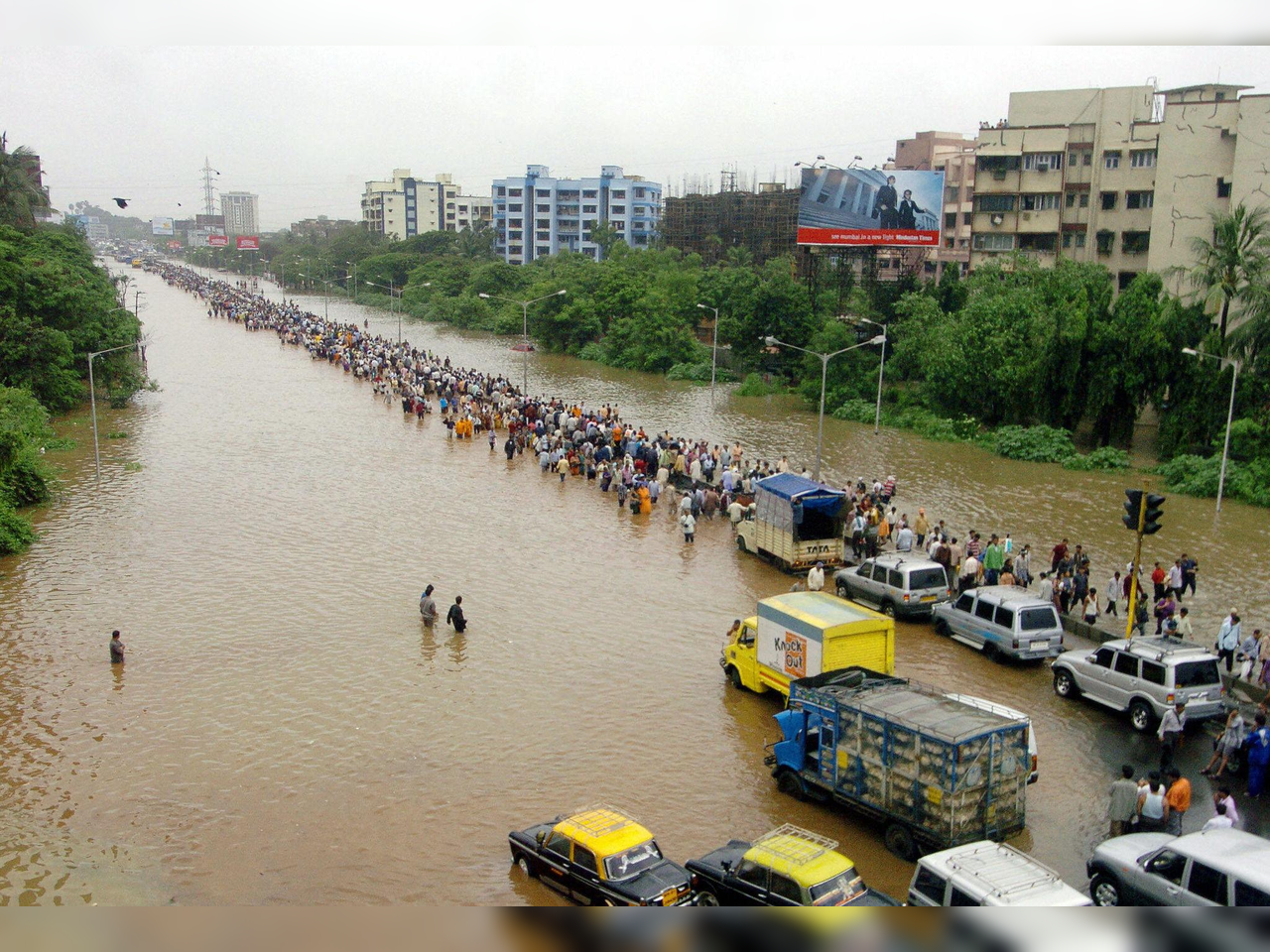
The rain was falling like sheets of water, turning everything grey. The sea seemed to have moved in into the street. The water was knee-high and the road to Churchgate, from where we were to take the local train to go back home to Kandivali, about 40km, was paved with cars, completely still. We heard that the train service had been stopped due to the flooding.
We spotted an empty taxi and almost forced its driver to take us in. He said we would have to pay extra: Rs 2,000, when the fare was usually Rs 600 to Rs 800.
A dancing SUV
Our taxi moved at a snail’s pace with other cars. The water, instead of subsiding, seemed to be rising around us. In one and a half hours, we had reached Worli. On a regular day we should not have taken more than half an hour.
The driver suddenly stopped the taxi. In front of us was an SUV floating on the water. Dancing, rather. Several feet of water had collected in the lane on the left, at the end of which the SUV had turned up. The taxi could not go any further. We stepped out and soon were wading through waist-high water, keeping as much distance as possible from the SUV. At that point the water was so high that I would have drowned. I am just 5 feet tall.
It was raining as hard as before. We were completely drenched. After some time, the water level seemed to be slightly lower in a particular stretch, where we found an auto-rickshaw. The driver agreed to take us as far as he could. Water sloshed about us, entering the auto, and stretched endlessly in front of us.
A strange darkness
By the time we reached Bandra, it was about 7pm and dark. The auto-driver dropped us here and we, again, plunged into waist-high water.
It was a strange darkness. It came from the water. Despite everything else that happened that day, and the trauma, the image of that darkness remains etched most powerfully on my mind. All electricity had been cut off, yet specks of light were flickering on the water. They came perhaps from battery-powered or other sources of light from inside homes and establishments, and from the mobile phones of the people out in the roads like us. These tiny lights lit up the water around us, which was moving in little waves, but filling up everything, like a massive creature descended menacingly on earth, and blending with the sky, which was as ominously dark as the water.
We began to walk along the main road, towards the north. Soon, we were part of a huge crowd, with more and more people coming out into the road, all pushing through the water, trying to get home or somewhere. Many office-goers were part of the crowd.
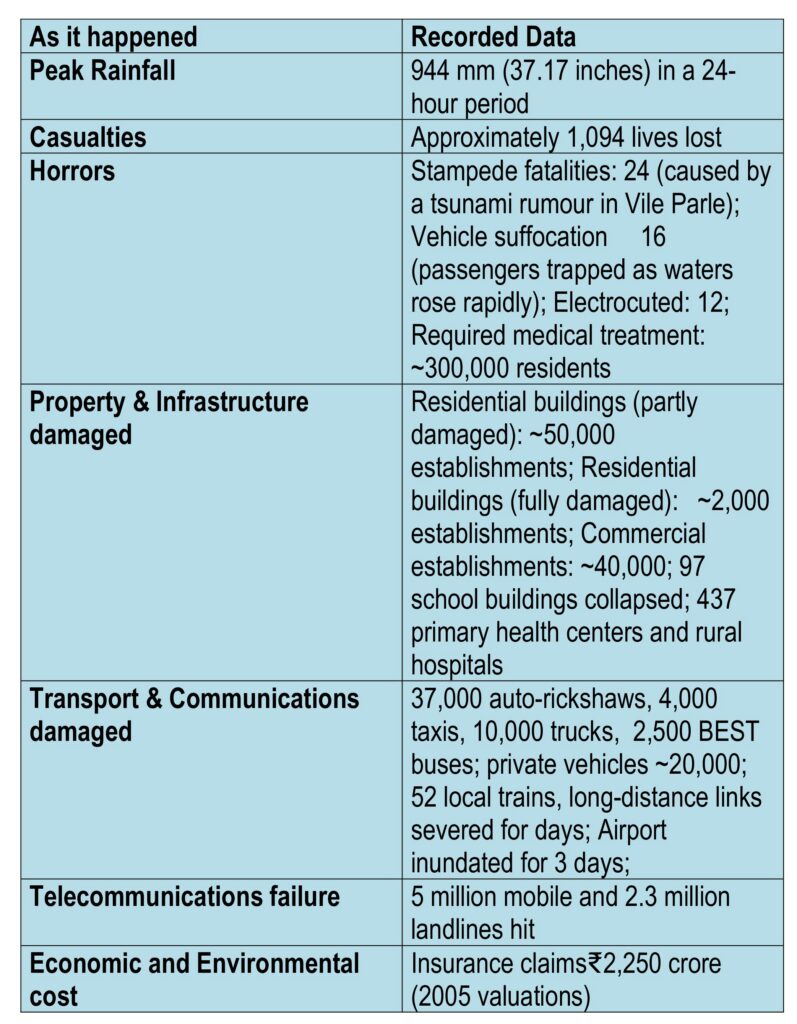
The flooded road was slowly turning into a river of humanity. Hundreds, thousands, lakhs (who can counts) were marching together in darkness in the city that day. More than a thousand people were to die from the flooding.
Horror news kept pouring in
Walking, pushing through the water, fighting all that was swimming towards us, plastic, garbage, and then, dead birds and dead rats and lots of things I could not really look at, we began to hear the horror stories. A group of teenagers, who could not get out of the car they were in, had died of asphyxiation; water engulfed a double-decker local bus, and several of its passengers died. Not very far from us, people in a flooded two-storey house had died.
And people were just disappearing in manholes.
I got a call from my sister, who was also in Mumbai, saying she was getting out from her office to get back home. We spoke once or twice again, and then her phone ran out of charge.
Since then, every time I heard of a death, because that was circulating frequently, my heart stopped a beat and I tried not to think of my sister. She survived, though, like me, to tell me later that she had got into a taxi somehow after a while with her colleagues, and had passed, among other things, dead buffaloes floating on the water.
Kept walking for hours
We kept walking for hours, till we reached Santa Cruz, which I now find was only about 4km from Bandra. I remember feeling exhausted. We had not eaten anything since we left the visa office, had the last sip of water a few hours ago and was shivering from being wet and cold. We fortunately found a small hotel, totally run-down, with sheets that did not look like they had been changed for months, and rented a room there. We were given some water, and, I think, a packet of biscuits. The room brought little comfort, except allowing us to step out of the water, which seemed as punishing and obdurate as before.
I could not sleep. The water level had not gone down. We ventured out again early morning and began to walk towards the next railway station, hoping that at some point the trains would start again. I think we managed to have a khullar of tea somewhere, and eventually reached Vile Parle station, another 4km or so. The station hardly had any place left for us to even stand. I remember waiting, standing, for very long, and falling asleep, supported by the thick forest of other bodies around me, till around 12 noon it was announced that train service would be resumed.
Reached 14th floor walking
I could only get into a train after 4pm, as the previous ones were extremely crowded, and eventually reached Kandivli station around 4.30pm. The road home from the station to our home, usually packed with unbearably noisy auto rickshaws, looked like a disaster zone – as if a bulldozer had razed everything that stood in its way. I stopped breathing when I thought I saw the body of a baby, a girl, lying on the road, only to realise that it was a doll. This is the second image of the flooding that haunts me.
My apartment was on the 14th floor and was hoping against hope that electricity had been restored. It had not been. I trekked on foot to the 14th floor, cursing the person who had invented highrises! The taps were running dry. But I almost cried to find out that my domestic help, who lived more than 1km away near Sanjay Gandhi National Park, had come over with her set of keys to my flat and had carried buckets of water from somewhere, making several trips up the stairs to my flat, so that we could at least wash ourselves. Almost 31 hours had passed since I had left home. About a thousand people had lost their lives in the flood in these hours.
‘Development’ facilitated flood
Experts have discussed in detail what could have caused the floods. Mumbai received the heaviest rainfall in 24 hours in 26 July, 844mm. What exacerbated its effects was an outdated, ineffective drainage system that was not repaired or upgraded, and was choked with plastic and garbage. Rampant unplanned — and often, unauthorised — construction, especially in north Mumbai, was another factor. Mangroves, a naturally protective ecosystem for the country’s financial capital, were being sacrificed in the name of development.
Some experts had pointed out the role the river Mithi, which had run through the city, had played. Or, did not play. The river had been choked with rubbish or been filled up in places. If the river had been healthy, the floodwater could have flown out of the city through it into the Arabian Sea. The extreme rain was also linked to climate change. Mumbai and adjoining areas had been experiencing excessive rain from a few years before 2005. This has been linked in particular to the warming of the Arabian Sea.
Has Mumbai learnt anything? No
Twenty-one years have passed since the flooding. The most important question that remains is if Mumbai has learnt anything. If only the rate of construction is looked at, well, no. One hopes that it does not rain like that once more.
Mumbai meri jaan: Loss and damage, 2005