
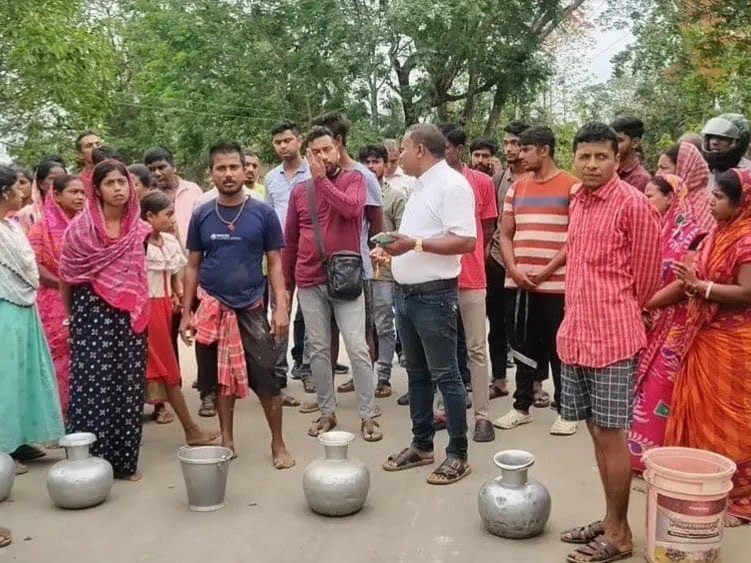

In April 2026, residents in Krishnapur constituency blocked the Teliamura–North Maharani main road, citing a two-week absence of water. In February 2026, a road blockade occurred in Kadamtala, North Tripura, regarding a prolonged drinking water crisis. The Bharatiya Janata Party’s ally, the local tribal-based party TIPRA Motha, might have won the tribal Autonomous District Council (ADC) election comfortably, but not everyone is happy.
Water-related unrest in Tripura, which has always existed, is intensifying as of early 2026. Residents, particularly women, are conducting roadblocks and protests against chronic drinking water shortages, mostly in hilly areas. Key agendas behind the protest include broken pipelines, high iron and arsenic contamination, and ineffective implementation of water supply schemes, prompting demands for immediate infrastructure repairs.
Significant social unrest
Water scarcity in Tripura, the southernmost state in Northeast India, has led to significant social unrest. A combination of over-arching factors, including environmental degradation from human activity, economic exploitation, and the accelerating effects of climate change, has deepened the crisis.
While total annual rainfall over the past decade has remained unchanged, data indicate substantial shifts in rainfall patterns, particularly in the state’s hilly regions, driven by climate change. Intense, short-duration monsoon downpours cause flash floods in river basins, but prolonged dry spells between October and May leave rivers virtually dry. Because the majority of Tripura’s rivers, including the prominent Gomati River, are predominantly rain-fed, these erratic rainfall patterns have severely disrupted water flow for much of the year, leaving many rivers dry for extended periods.
Forest ecosystems tinkled
Compounding this issue is the alteration of forest ecosystems due to large-scale plantation programs focused on plains and urban zones. Experts emphasize that successful afforestation requires carefully selecting trees that align with local ecological conditions, temperature range, rainfall levels, soil type, pH balance, and drought tolerance, which is often not followed.
Preference should be given to native trees since they are naturally adapted to local environments and support regional biodiversity, including vital pollinators like birds and butterflies. However, these critical scientific considerations were largely overlooked in Tripura’s plantation efforts, leading to unintended ecological consequences that exacerbate the environmental challenges facing the state. Moreover, unscientific tree planting has exacerbated soil erosion in the upper catchment of rivers, leading to elevated riverbeds.
Water contamination
Meanwhile, Agartala’s urban sewage system is directed into the River Haora, the primary source of municipal water supply, creating significant health risks for residents. Although discussions about making rainwater harvesting mandatory for large housing complexes and government buildings have been ongoing since 2007 to mitigate runoff, the administration has completely failed to implement this decision.
Groundwater in Tripura suffers from significant contamination, with studies highlighting high iron levels, faecal coliform, and elevated turbidity. Poor sanitation infrastructure leads to sewage seeping into aquifers, especially in shallow areas. This has caused widespread waterborne diseases, with reports showing over 100 deaths in four years due to waterborne diseases in the state.
A study published in the Journal of Geological Society of India in 2025 noted that leachate from septic tanks and inadequate sewage disposal significantly contaminates shallow aquifers. Groundwater in areas like the Dhalai district frequently shows high iron levels far exceeding WHO and BIS standards. Studies show that even Agartala’s groundwater quality is poor, with the highest contamination occurring during pre-monsoon periods.
Aggressive hydrocarbon extraction
Another contributing factor to the water crisis is hydrocarbon extraction in the hill areas, which has been ongoing for decades. Drilling rigs, pipelines, and other infrastructure have encroached upon ecologically fragile terrains, contaminating streams, groundwater, and soil.
These activities have jeopardized the availability of clean water for local communities. Tripura’s hill regions fall under the Sixth Schedule of the Indian Constitution, designed to safeguard Indigenous self-governance over land and natural resources. The Tripura Tribal Areas Autonomous District Council (ADC), established in 1984 after enduring a protracted political struggle, now manages nearly two-thirds (82.79%) of the state’s forest land. Yet despite their control over surface lands, subsoil resources like oil and gas remain under state jurisdiction.
Incidentally, ADC officials have expressed concerns about the Oil and Natural Gas Corporation (ONGC) expanding its operations in hill areas without proper consultation or consent from local communities, a grievance that directly contradicts principles of local autonomy.
According to the Economic Review of Tripura 2021–22, the state’s gas reserves consist of approximately 97% methane. Promoted as a “clean” energy source with the potential to fuel electricity generation and industrial development, these reserves are being aggressively tapped using advanced technologies like “Managed Pressure Drilling” (MPD). While such advances have enabled ONGC to penetrate previously untouched forest interiors, this expansion has had detrimental effects on water systems.
The environmental toll is evident in widespread pollution resulting from chemical discharges, drilling waste, and pressure releases. These contaminants often recur during the monsoon season when rising water levels obscure damage until it accumulates over time. Downstream communities experience the impact first-hand: rivers originating in Tripura’s hills traverse multiple villages before eventually flowing into Bangladesh. Villagers today avoid touching river water due to its contamination. ADC officials have accused ONGC of releasing waste into rivers during elevated water levels without warning nearby residents. This negligence has significantly harmed aquatic ecosystems and caused severe health problems for humans who rely on the polluted rivers for daily needs. Even vegetation along affected waterways struggles to survive.
Forest Rights Act ignored
Further complicating matters is the inconsistent enforcement of critical legislation like the Forest Rights Act, which was intended to restore community ownership of natural resources. At its core, this ongoing crisis represents a deeper conflict over sovereignty, centered on local communities’ ability to reject external projects that irreversibly alter their land, water sources, and traditional ways of life. As environmental degradation continues unchecked, the people of Tripura face mounting challenges in their fight for sustainable solutions and equitable governance over their vital natural resources.