
Serader Sera Nirmal Puja Puroshkar, the green Puja award, was launched by the non-profit EnGIO in 2007. In its eighteenth year now, it has helped to make Durga Puja more environment friendly and to advocate social responsibility to Puja organisers. The award has been supported by government organisations and agencies, corporate organisations and other non-profits, including West Bengal Pollution Control Board, Kolkata Municipal Corporation, Climate Action Network South Asia (CANSA), Vikram Solar, Exide and Indian Oil. The Plurals is the media partner of the event that had 300 Pujas applying. A shortlist was made of 75 Pujas, which were split into seven zones.
Judgment criteria:
Close to 50 jury members, including environmentalists, experts, academics, consular officials and senior government officials participated in the judging process that continues over four days. The Pujas were judged on the basis of a range of parameters including themes and their execution; use of eco-friendly materials in pandal construction; energy conservation; use of non-toxic paints in image making; maintenance of noise, safety and disaster management norms; and contribution to society.
The jury:
Jury members for north Kolkata were Arpita Halder, Associate Professor, Tamralipta Medical College & Hospital, Pritha Bhattacharya, Associate Professor, CU, and academic and senior EnGIO official Sujata Basu.
Themes:
The theme of Lalabagan Nabankur, ‘Karagar’, focussed on the prison of plastic that the seas have become. Though the idea is extremely relevant, the judges felt plastic had been used excessively. Uttor Kolkata Sanhati Sporting Club tried to execute the theme of ‘Sanhati’ (unity), with a subtle collage of a few of the best examples of craftsmanship of Bengal.
Hatibagan Sarbojanin Durgotsab Committee’s ‘Atho ghat kotha’ (Story of the ghat) highlighted the time when nearly hundred ghats stood like sentinel along both banks of Hooghly. Their presence was woven into the very rhythms of the city but now they are silent, absent from history and public memory. Tal Betal’s ‘Lokkho taray aloye bhora’ (The light of thousands of stars) described biodiversity, showcasing fireflies.
Pathuriaghata Pacher Pally Sarbojonin Durgotsab’s theme ‘Ei shohor shei samoy’ (This city, another time), a comparison between the old art forms and contemporary digital arts, featured ‘Battala’ art and printing of books and panjikas, intricate woodcut illustrations and the beauty of lithographs. Jorasanko 7er Palli Sarbojonin Durga Puja’s ‘Patrepallabi’ used dried leaves as a reflection of a dying society and a prayer to Maa Durga for environmental protection.
Shimla Byam Samiti’s ‘Vande Mataram’ was a tribute to the freedom fighters. Subhas Chandra Bose had started this Puja, which became a symbol of the freedom struggle. Wellington Nagarik Kalyan Samiti showcased the aspiration to move from darkness to light: ‘alor utso’. Only the light of the mind can change society. Shyampukur Sanghatirtha Durga Puja Samity had for its theme ‘Harano sur’, a reference to the various professions and their sounds around us earlier, now replaced by their modern counterparts such as the smartphone.
The topper
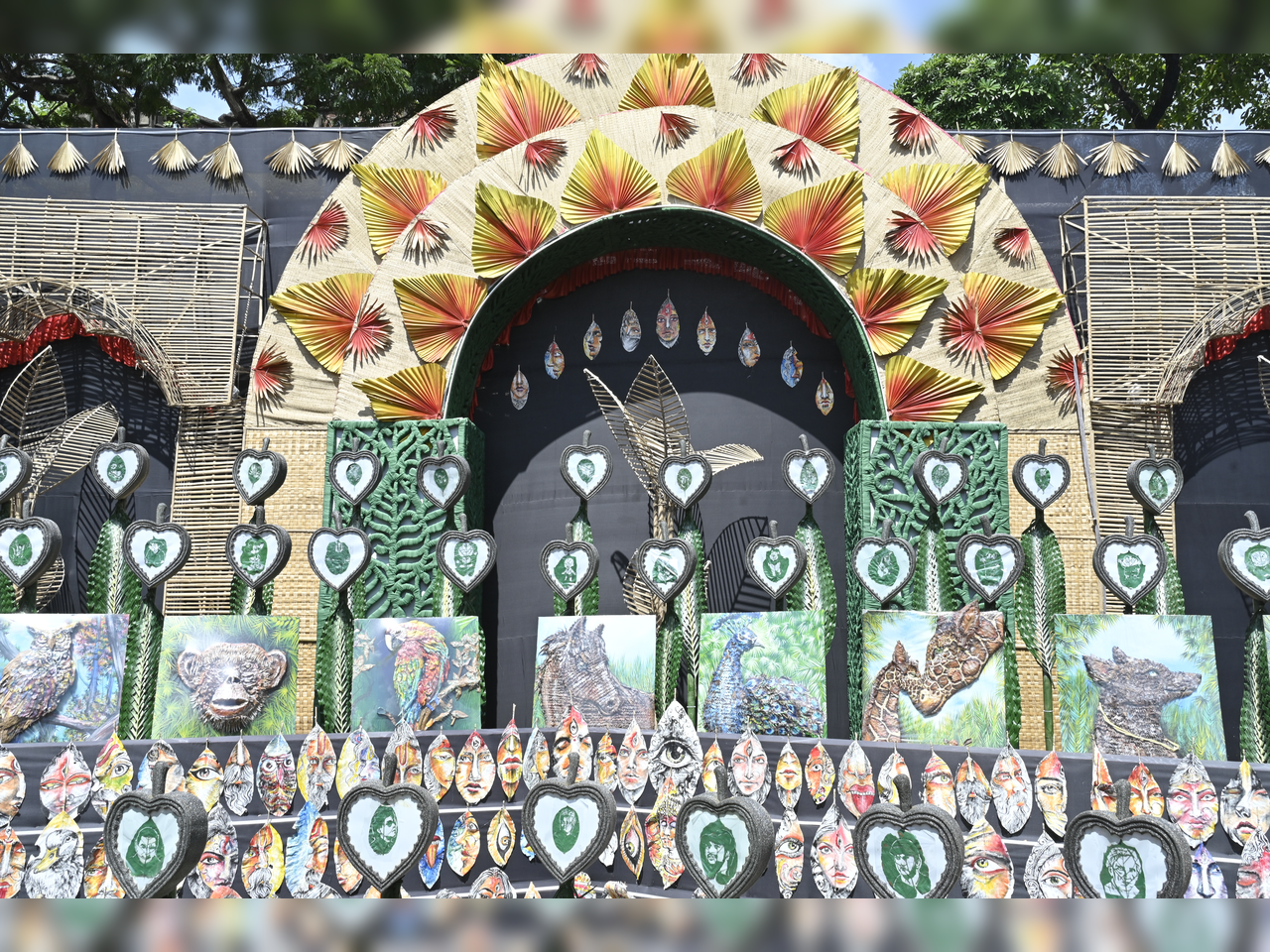
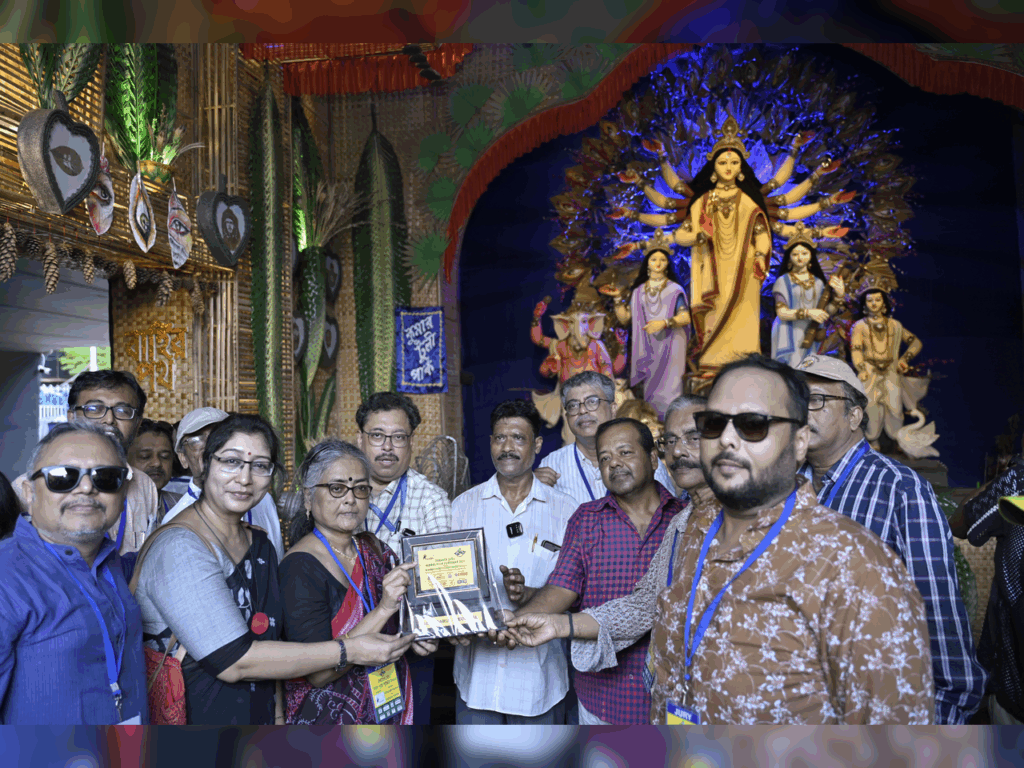
The best Puja, according to the jury, was Kumartuli Park Sarbojanin Durgotsab Committee. The theme was beautifully executed with minute detailing: each and every leaf bore different portraits and sketches. Even the canvases were made of different kinds of leaves. Highlighting the environmental aspects, the jewellery of all the idols were made of different varieties of leaves that were chemically treated. They had procured the leaves from different sources and will try to recycle them and put up the other elements used for auction.
“The theme of Kumartuli Park Sarbojanin Durgotsab Committee wonderfully showcased how in addition to flowers, the beauty of a tree also lies in its leaves. The Puja wonderfully argued through that the world is actually a huge leaf colony that stands for harmony and friendship and also promises to offer a peaceful, beautiful world, free from conflict, to the next generation, so important in this time of conflict around the world,” a jury member said.