
An earthy farmer woman drags a plough, its tip buried inside the earth, as she looks ahead with grit. There is a sublime glow on her face. Tagging along is her favourite child, a boy with a trunk of a nose who clutches a bunch of plantain leaves with his left hand and makes a giving gesture with his right. His three siblings stare at them with expectations that their endeavour will yield a bounty.
This is how Durga greeted her devotees at Tala Prattoy this year. This north Kolkata Puja had turned out to be an award as well crowd favourite this year— the footfall in 2024 was 12 million people, while it was nearly 20 million this year; claimed an organiser — through innovative installation art that sought to deliver a message. The theme this year was ‘Beej Angan’, or ‘the seed courtyard’; the idea was to draw our attention to indigenous seeds in particular and to what we are doing to our food chain in general.
The theme
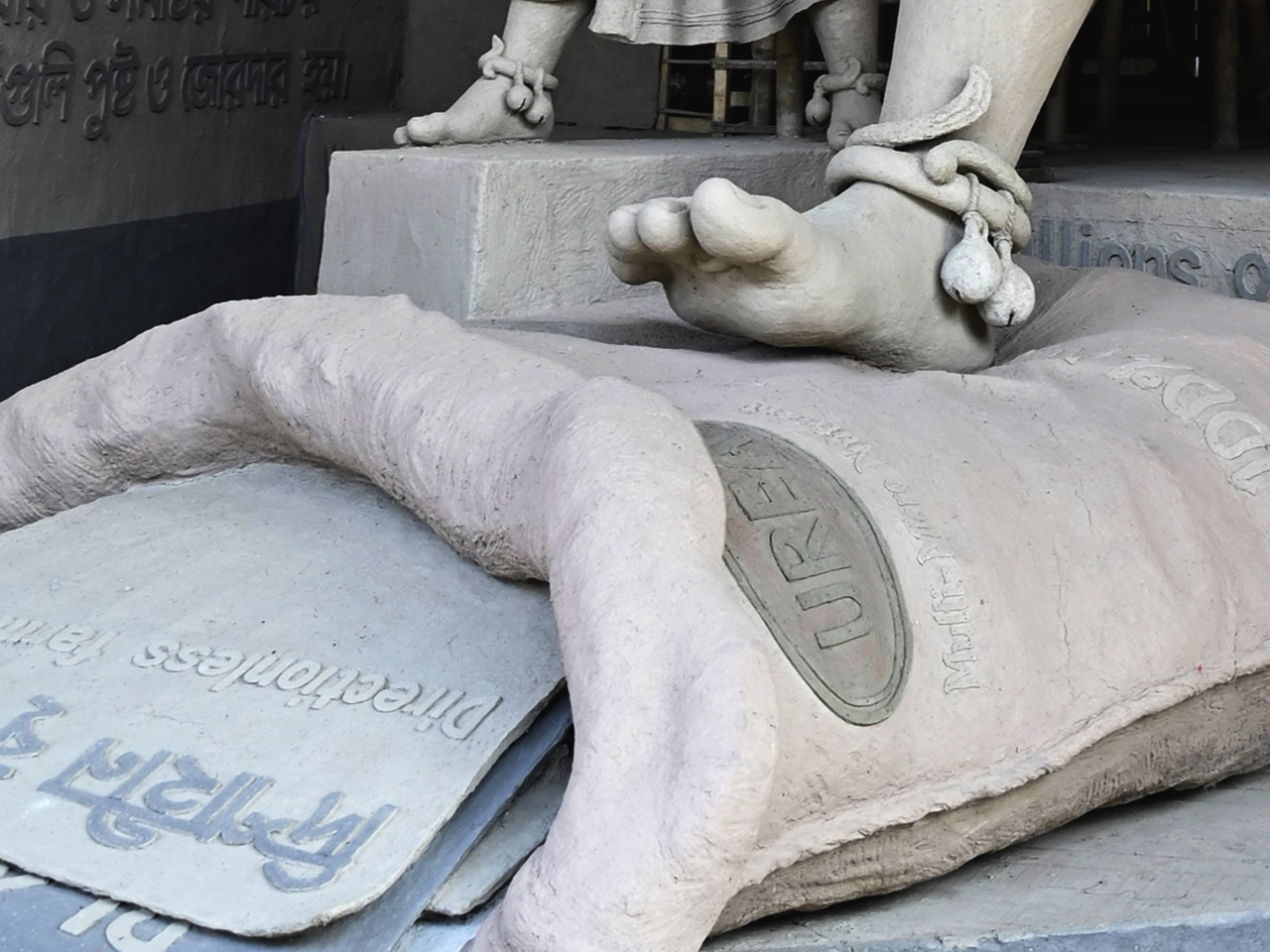
The earthy Durga here was not shown here in her usual pose, killing Mahishasura. Here rather, she stepped on a bag of urea — symbolising the unregulated infusion of chemical fertilisers and pesticides in our agriculture for the better more than half a century now. The bag was found to squeeze out a clutch of treaties that the State has agreed to, which control the farmers’ fate in the guise of globalisation and free trade.
On one side, a shelf showcases a mouse, an owl, a duck / swan and a peacock — the mythical vahanas that ferry Durga’s children Ganesh, Lakshmi, Saraswati and Kartik who play a real role in the agricultural ecosystem: by burrowing the land, making it arable; by preying on pests and weeds; and by adding manure to the soil.
The message
This little group is surrounded by graffiti that seeks to explain the concept that artist Bhavatosh Sutar tries to bring to life. A sample:
· Food is not just fuel for the body. Rather, food is about family, about community and identity. “And we nourish all those things when we eat well”
· Monoculture and how we have “pitted equity against ecology and sustainability against justice”. It says
· Soil is the mother who gives, to whom you must give back
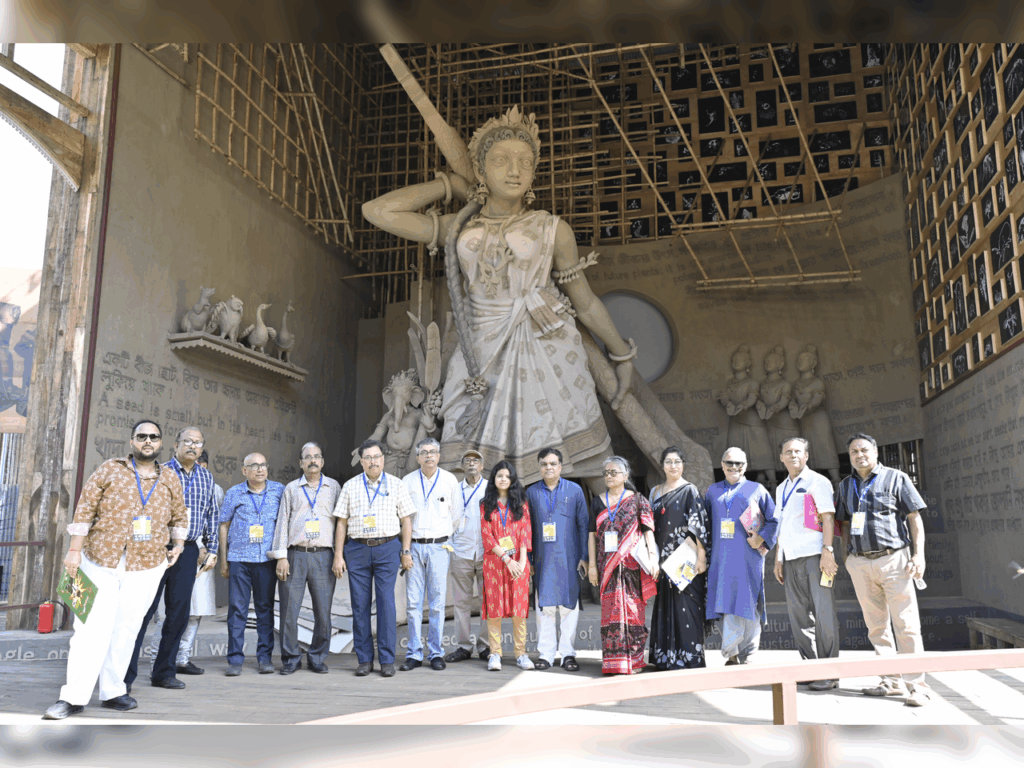
The one that best summarizes the concept was perhaps: “A seed is small but in its heart lies the promise of forests.” Atop of the block that houses the farmer Durga and her family is the slogan, Manush ekmatro jeeb je nijer khabare beesh meshay (Humans are the only beings who poison their own food). This key, and extremely strong, message was supported by installations all along a large complex of which the idol house was one part.
Right at the entry gate, a giant replica of a cauliflower greeted visitors to drive home the benefits of indigenous seeds. Inscriptions on panels along the walkway help explain the concept. These included a quote from environmentalist Vandana Shiva, whose writings, along with many others including his own memories of childhood, triggered the concept in Sutar’s mind. As an elevated shaded corridor rook the crowd on a recce, there were several other installations to draw their attention while the queue kept moving. These showcased the effects of commercialisation and chemicals and the traditional concept of gola, a village-based community storehouse for grain and seeds.
Two performing arts installations presented the case of how the brain is the biggest seed — a vault of information that we keep and overwrite — and inauspicious collapse of the insect world around us. A group of tireless performers kept these alive through the sweltering autumn humidity.
Conversation continues
Underneath this elevated corridor a chamber scripted the story of how Sutar’s concept fructified. It also housed a collection of paddy seeds — more than two hundreds — and an inventory of sacks full of paddy that were cultivated from some of them.
At the end of the Pujas, the organisers opted for an on-the-spot washing down of the clay idol to avoid further polluting the Ganga. Speaking recently to The Plurals exclusively, Sutar expressed hope that the theme might be preserved. Whether or not that happens will only be known in future, but at least for the duration of the celebrations and immediately beyond such installation art and performances have definitely spurred a conversation among millions on something that affects all humans — irrespective of community, caste, creed and gender: The seed and our food.
Sutar’s upcoming book on the Tala Prattoy’s theme is expected to prolong such conversation.
Joyjeet Das is an independent journalist