
Serader Sera Nirmal Puja Puroshkar, an award launched by the non-profit EnGIO in
2007, is a pioneer in introducing in environmental consciousness to the Durga Puja. It has also advocated social responsibility on the part of Puja organisers. The award has been supported by government organisations such as the West Bengal Pollution Control Board, Kolkata Municipal Corporation and other state government departments and agencies, along with corporate organisations, academic institutions and other non-profits, such as Exide, Indian Oil, Vikram Solar and Climate Action Network South Asia (CANSA). The Plurals is the media partner of the event. The awards shortlisted 75 participants from 300 Pujas that had applied. The shortlisted Pujas were split in seven zones.
Judgment criteria
Close to 50 jury members, including environment experts, academics, consul generals and senior government officials, participated in the judging process that continued over four days. The Pujas were marked on the basis of a range of parameters, including themes and their execution; use of eco-friendly materials in pandal construction; energy conservation; use of non-toxic colour in the images; maintenance of noise norms, safety and disaster management provisions, as well as contribution to society.
The jury
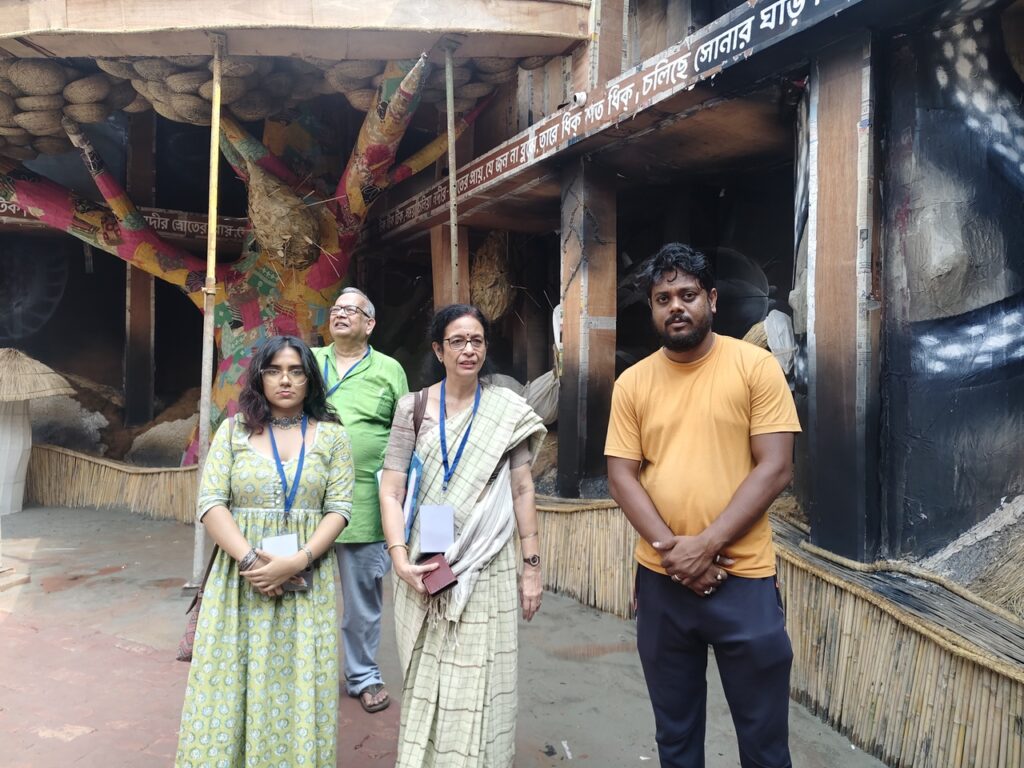
The jury members for the south Kolkata sector, spread over Behala and Haridevpur, were journalist and academic Buroshiva Dasgupta and academic Mahalaya Chatterjee, who specialises in urban economy.
Themes
The first visit was to Lake Gardens People’s Association, featuring the theme ‘Agnigorbha Maabela’, where the installation showcased psychological and physiological effects of childbirth on women. Haridevpur New Sporting Club featured Kintsugi, the Japanese practise of repairing pottery with lacquer mixed the powdered gold, silver or platinum. This craft symbolises both resilience and the beauty of imperfection.
Haridevpur Adarsha Samity showcased the theme ‘Bilashi’, intricately capturing details of nineteenth-century Bengal life and society, with statues and artefacts, among other things. Behala Debdaru Fotok Sarbojanin Durgotsab Committee, with the theme ‘10 foot/ 10 foot’, showcased the difficult transition forced by development in the movement from village mud huts to a concrete structure, with a graveyard representing this struggle. Tarun Matri Sevak Samity traced the history of Behala from 12th Century; Nandana Yuva Sangha beautifully depicted the simplicity and struggles of village life.
‘Uronto’, the theme at Shakuntala Park Netaji Sangha, replicated the famous pigeon towers of Egypt, symbolising the freedom of birds — a fact reinforced by the absence of the caged pigeons. Sabarnapara Barisha Sarbojoniin Durgotsav offered a tribute to the Harappan civilisation. Barisha Club’s theme, ‘Abolished Clowns’, focused on the plight of circus performers in current times. Thakurpukur State Bank Park Sarbojanin, themed ‘Pratno Kotha’, was based on the Mogolmari excavation in West Bengal that led to the discovery of Buddhist viharas.
The Topper
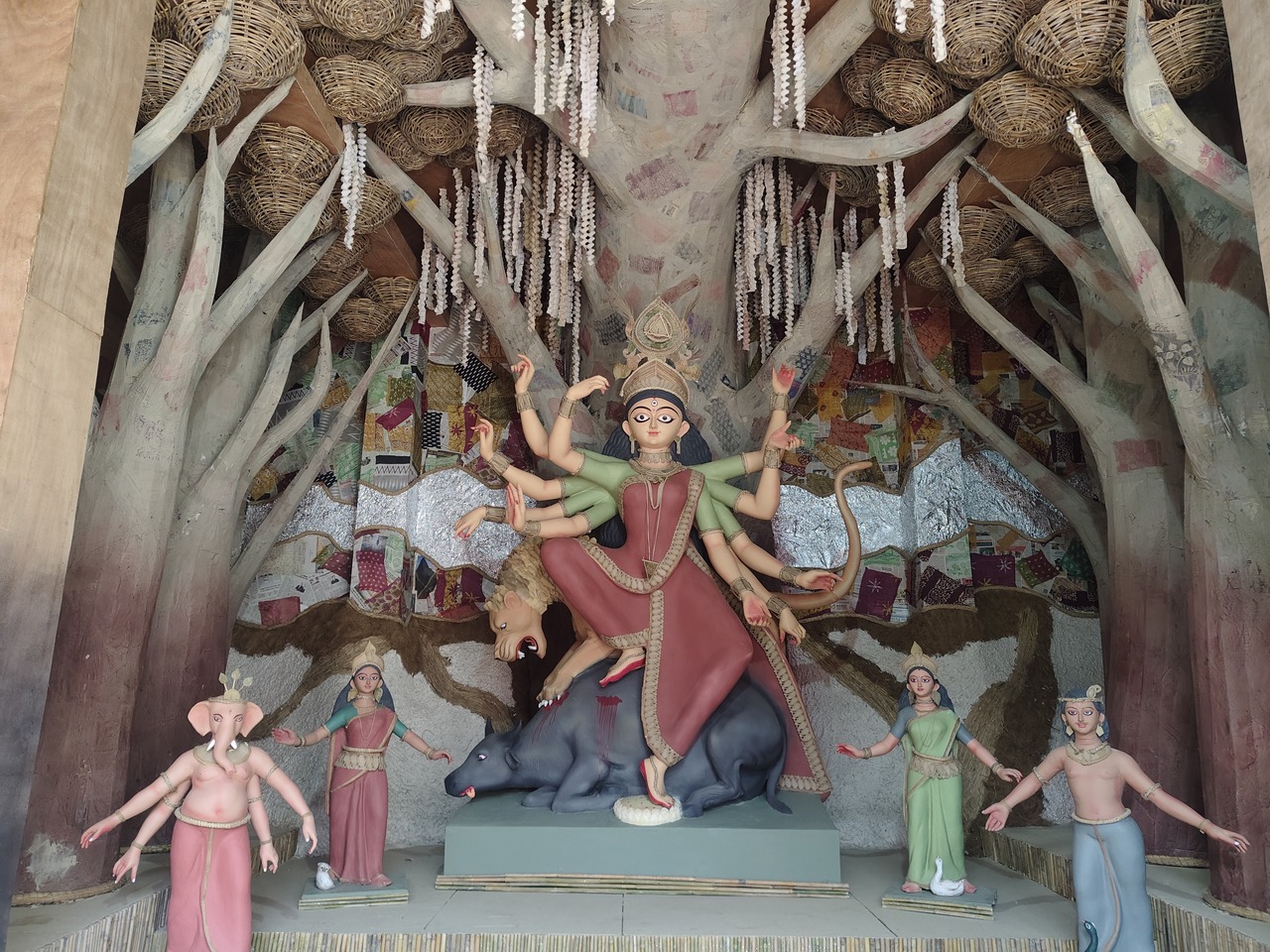
Behala Buroshibtala Janakalyan Sangha, a relatively smaller-budget, heartwarming Puja, used eco-friendly materials creatively to depict several aspects of pollution and the climate crisis. The theme ‘jol, jongol, jomi, jibon’ spoke about the fundamental connection between aspects of nature and our existence. Life does not only belong to humans, but also to the birds of sky, the animals of the forest, the fish in the river and the countless creatures underground. This Puja was inspired by the Chipko movement and the earlier sacrifice of Amrita Devi of the Bishnoi community, who died to protect trees from being felled.