
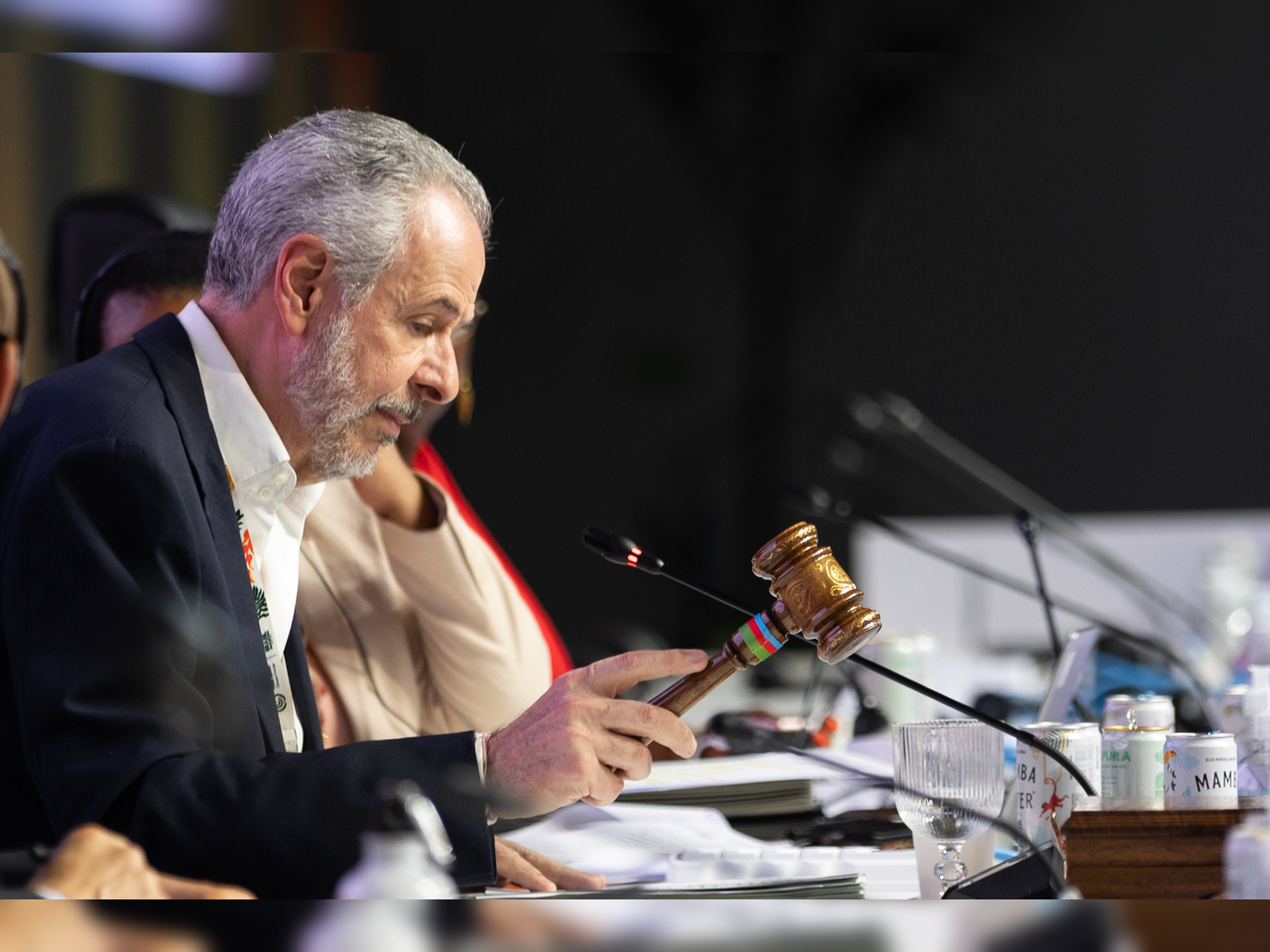

The COP of truth, as Brazilian president Lula had christened COP30, took on an ironic overtone as the global climate summit concluded on Saturday afternoon in Belém (early Sunday morning in India), with a weak and compromised final draft exposing the hard truth of discord within the Global South and Global North countries.
While UN experts hailed it as “successful” despite challenges to the process, vulnerable least-developed countries and activists criticised it for not doing enough for finance and fossil fuel cuts, though admitting that the Belém outcome looks better than Baku for bringing back key issues of climate justice on the table.
The final draft, which got accepted after a fair share of drama with several countries raising objections even after it was sealed, was praised for announcing the Just Transition action plan and a gender-based action plan, but the core issue of finance, particularly adaptation finance, continued to be pushed back without adequate commitment from developed countries. The plenary had to reconvene in a rare exception to the COP process where the text initially presented was accepted with the caveat that the contentious issues of fossil fuel cut roadmap and indicators of Global Goal of Adaptation (GGA), which will be observed by the UN globally for progress, will be discussed at Bonn in June 2026.
Least-developed vulnerable countries and emerging economies, including India, need funds for adaptation. The Adaptation Fund Board officials recently shared with The Plurals that the board could not even generate 40 per cent of its minimum requirement of USD 300 million for 2026 from the just concluded summit. According to the board, projects worth more than USD 1 billion, including in India, are waiting to be funded. Incidentally India has six projects approved by the Adaptation Fund Board, the last one in 2016.
Officially India praised the outcome of COP30, observing it reaffirmed the “commitment to equity, climate justice and global solidarity” in climate negotiations, but in private, senior Indian negotiators observed that they expected a better deal on adaptation finance.
“COP30 was called the COP of implementation and the COP of adaptation but it worked, and walked, almost in the opposite direction,” said a climate activist at Belém. A representative from a highly vulnerable small island country pointed out that more needs to be done to keep the global temperature rise within 1.5°C compared to the pre-industrial levels for saving their vulnerable communities.
UN claimed to keep Paris agreement alive
“COP30 showed that climate cooperation is alive and kicking…194 countries have stood firm in solidarity (and) rock-solid in support of climate cooperation,” claimed Simon Steil, executive secretary of UNFCCC (United Nations Framework Convention of Climate Change) on Saturday evening after the climate meeting came to an end.
“On to the negotiated text, the first is, we reached unanimous agreement on key agenda items like Just Transition, gender and the tripling of adaptation finance…194 countries agreed that 1.5 degrees is still our goal,” said the official.
The official mentioned paragraph 10 that reads: “The global transition towards low greenhouse gas emissions and climate-resilient development is irreversible and the trend of the future,” and claimed that the Paris Agreement mandate in 2015 has been kept alive in Belém, on the 10th anniversary of the Paris Agreement.
Outcomes and their analysis
The key outcomes are:
● Countries agreed to launch the ‘Global Implementation Accelerator,’ a two-year plan to close the gap between current national climate plans and what is required to keep 1.5°C limit within reach, including COP28 agreements to transition from fossil fuels. But the challenge is to turn the plan into implementation on ground .
● Countries agreed to develop a Just Transition mechanism to enhance international cooperation, technical assistance, capacity-building and knowledge sharing. However, there are question marks on its efficacy without enough financial support.
● COP30 President André Corrêa do Lago announced the creation of two roadmaps on deforestation and on transitioning from fossil fuels; essentially a compromise to counter the criticism for not keeping these within the final text.
● Rich countries committed to a tripling of adaptation finance as part of the USD 300 billion NCQG by 2035, meaning that roughly USD 120 billion of the USD 300 billion climate finance goal will be dedicated to adaptation measures in the most vulnerable countries. This is almost a repetition of an earlier COP decision, which so far has failed to reach the target for three successive years.
● Countries agreed on a two-year work programme for the delivery of climate finance including the USD 300 billion, as well as a high-level ministerial on the quality and quantity of the new climate finance goal agreed at COP29. Another exercise to push back the actual support, pointed out many reminding that the Baku-to-Belem USD 1.3 trillion roadmap has just been finalised.
● USD 250 million was pledged for distribution to projects under the Loss and Damage Fund starting immediately after COP30. Activists hailed this as a first-of-its-kind announcement, but observed the amount was too little.
● USD 300 million was pledged for the Belém Health Action Plan to support the health sector’s adaptation to climate change, a welcome step if executed. India, one of the major countries being affected by climate change, is not part of it.
● Over 80 countries signalled commitment to a roadmap to transition away from fossil fuels, including 24 countries signing the Colombia-led Belém Declaration. This seemed to be gathering momentum; but currently only on the unofficial agenda of the COP presidency.
● More than USD 1 trillion was committed by 2030 to expand power grids, energy storage and more investments in the energy transition. Studies show many of these kinds of announcements do not get implemented in the long run.
● 18 governments signed on the Declaration on Information Integrity on climate change; most governments are still out of the ambit.
● Brazil launched a new Integrated Forum on Climate Change and Trade to coordinate climate-aligned trade policy and create a “safe space for dialogue” among trade and climate officials; first time the trade has infiltrated climate talks.
● Brazil, EU, China, UK and others, accounting for around 20 per cent of global emissions, agreed to a Global Carbon Market coalition at the pre-COP Leaders Summit. These are pledges beyond UN process, and though important, hardly has any UN mandate.
● Similarly, a global Intergovernmental Land Tenure Commitment was launched by 15 governments. Again, this is not an official platform.
Hope hangs on but political will criticised
Arunabha Ghosh, South Asia Climate Envoy to COP30 Presidency & CEO, Council for Energy Environment & Water (CEEW), pointed out: “In a year where climate multilateralism has been challenged, getting a reasonable to good deal was better than failing to get any deal in pursuit of the best deal,” referring the steps proposed in the final draft.
“We need genuine investment pathways, honest recognition of the scale of loss and damage, adequate concessional finance,” observed the expert.
“We leave Belém with a historic victory for people power, but a devastating failure of political will from the Global North to deliver climate ambition and finance,” said Harjeet Singh, global climate activist and also founding director of the Satat Sampada Climate Foundation.
“We celebrate the decision to develop the Just Transition mechanism and the announcement of a roadmap to transition from fossil fuels as a win for workers and communities; but without a concrete commitment to robust public funding, the transition to a greener future remains a mirage,” he added. He hailed the rolling out of the Loss and Damage Fund, but criticised the little money being placed in the mechanism.
“The finance related outcome is utterly unacceptable. By refusing to put real numbers on the table and shifting the burden on to developing nations, the EU and other rich countries are trying to escape their legal and moral obligations of providing public finance as per Article 9.1 of the Paris Agreement,” Singh alleged.