
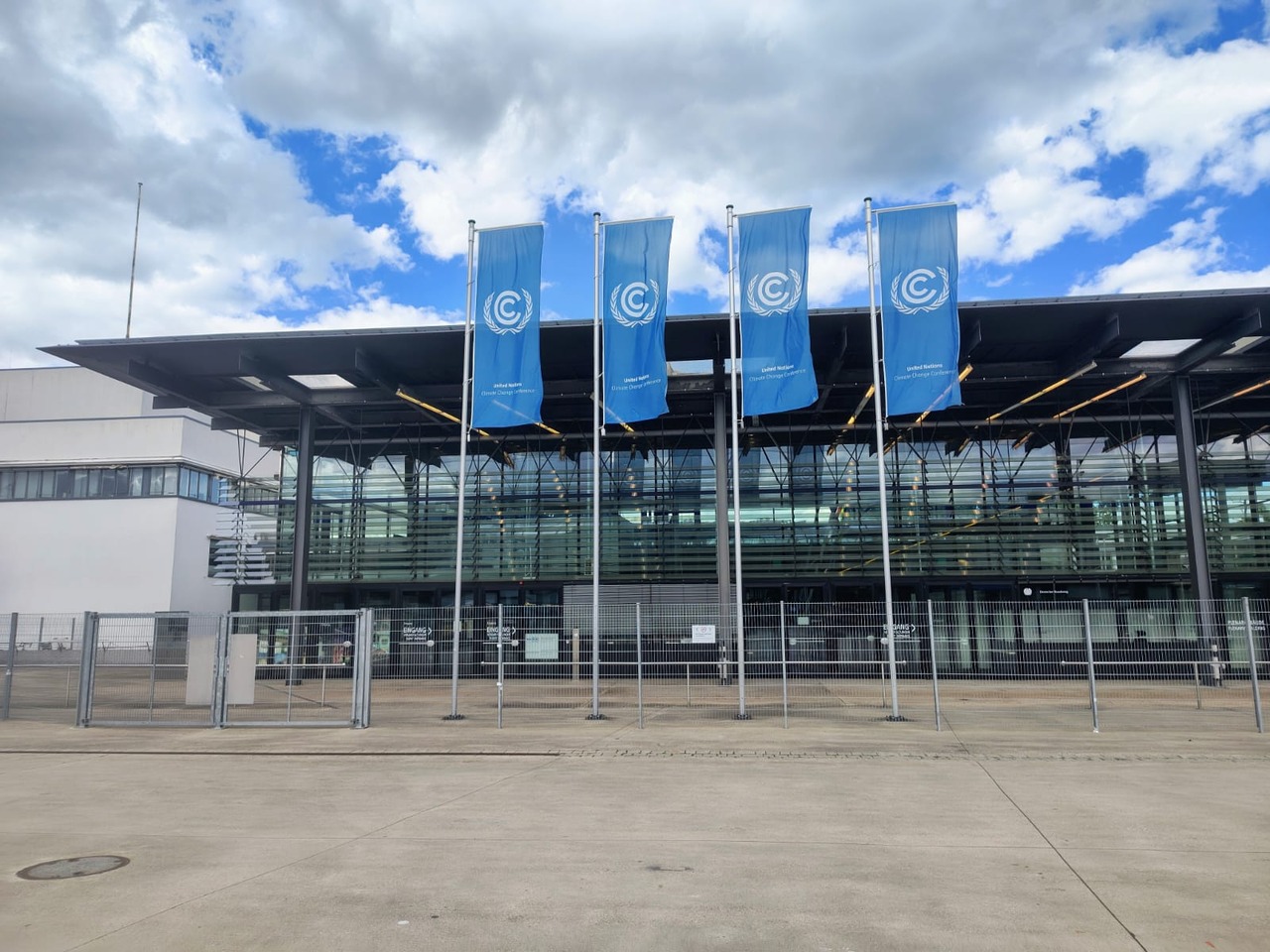

In its first plenary statement at the UN SB (Subsidiary Bodies) 64 climate meeting in Bonn, India emphatically pointed out that developed countries must address the issue of climate finance.
Reading out India’s statement (https://docs.google.com/document/d/1_5r6–aBsw1hD8l79uQ2leuY7ouzX7gi/edit?usp=sharing&ouid=111215281264008339590&rtpof=true&sd=true) Harkeerat Singh Randhawa, second secretary at the Consulate General of India at Berlin, highlighted the dwindling levels of climate finance from the global North, which is affecting the global South.
The annual UN SB meet is considered the platform where the agenda is set for the major annual UN climate meet, COP, to be held in Turkey and Australia during next November. On Tuesday, the second day of the climate summit, Simon Stiell, executive secretary of the United Nations Framework Convention on Climate Change (UNFCCC), responding to a question from this correspondent, said that while UNFCCC values all important voluntary initiatives, whether any such initiative would be included in the formal UN discourse must be decided by the negotiating partnership under the leadership of the COP presidency.
Growing gap in finance
In its statement, India remained focused on placing the onus of climate finance on the developing world.
“India believes that the international climate agenda must now focus on implementation (and) we ask that the Article 9.1 work programme receive the prominence and dedicated agenda space it deserves,” the Indian statement says.
Article 9.1 of the Paris Agreement mandates that developed countries should provide financial assistance to developing nations to meet the requirements of climate action, including mitigation and adaptation, consistent with their obligations under the UNFCC.
“We are concerned (with the) declining levels of climate finance, including replenishment and support and the growing adaptation finance gap. Discussions on the implementation of Article 9.1 should address these realities directly,” says the statement.
Adaptation finance ignored
In 2023, global climate finance reached its highest level at $1.9 trillion, propped up mostly by private investment. But the amount still falls short by a huge margin of the estimated $6 trillion to $7.4 trillion that is required annually to meet the financial challenge of climate change.
Experts point out that more worryingly, over 90% of the funds are invested in mitigation initiatives, such as renewable energy and electric vehicles because of fast financial returns. Only about 3.4% is currently invested in adaptation initiatives, which require long-term engagement for adequate results. India’s millions of climate-vulnerable people, like those in Sundarban, need the support of adaptation funds for survival.
Equity back in negotiation
India also brought the concerns of climate-related equity and historical responsibility back into the discourse. It is generally believed that India, alongside developing and less developed country blocks, allowed the equity and responsibility issues to be diluted in Paris in lieu of the unanimous agreement that made it mandatory for all countries to cut emissions, though in variable scales.
“Equity and historical responsibility must continue to guide this phase. Developing countries need adequate carbon space to eradicate poverty, expand energy access, and meet their sustainable development goals. Therefore, developed countries must lead through accelerated emissions reductions,” said India’s statement.
It stressed the “operationalisation of the Just Transition mechanism based on equity and CBDR- RC (common but differentiated responsibility – respective capability)”.
Fossil fuel geopolitics
India also stressed that no “new issues and obligations beyond agreed mandates” should be part of UN climate change negotiations, even as it asserted its firm commitment to climate multilateralism and its effective implementation. “No new issues or obligations beyond agreed mandates should be considered. Initiatives outside the UNFCCC process should remain voluntary in nature,” says the Indian statement.
Many climate analysts at Bonn believe that the Indian statement came in response to a growing demand from civil society, after the Santa Marta fossil fuel treaty meet in Colombia in April, that COP31 should formally include more precise UN-led actions for cutting fossil fuels.
The meet, the first international conference on transitioning from fossil fuel, was co-hosted by Colombia and the Netherlands and was attended by 57 nations to establish practical legal, financial and economic pathways to phase out coal, oil and gas. India did not participate in the event, but both Turkey and Australia, the designated presidency of COP31 and the designated head of negotiations in COP31, did. The leaders from both countries refused to respond directly to The Plurals questions in Bonn about the possibility of stronger fossil fuel cut, beyond what has been agreed so far, becoming the agenda in COP31.
The Indian statement mentioned climate change-linked trade issues, pointing out that “the dialogue on unilateral trade measures should address its negative impact on climate actions of developed countries”.