
Water, essential for our life; livelihood; food security and sustainable development, is a natural resource and considered as a renewable one since we get fresh water as rainfall which amounts to annually 4000 BCM (billion cubic meter) on an average in India.
India, having around 18 percent of world population and 2.5 percent of earth area, has only 4 percent of the fresh water underlining the limited availability of water resources in our country. In our country, per capita availability of water is decreasing at a fast rate and it is currently less than one-third of the quantity that we had during independence in 1947. Today, water-stress and water acute conditions are prevailing in many regions of the country and as a result, which has a direct bearing on the health of the people.
In our country, public water supply systems are executed, operated, and maintained by the state governments with partial financial support of central government. As per norms, water must be safe to drink and use of clean unpolluted water reduces disease burden considerably.
Sanitation is a key agenda
Another important issue with respect to public-health point of view is sanitation. Use of toilets and safe-sanitation practices reduces disease burden among the people considerably. Encouraging results of disease-burden reduction have been reported after achieving open-defecation-free (ODF) status in various parts of the country. Better liquid and solid waste management is also critical in the context. Parallelly, common people must be aware, motivated and sensitized on domestic and environmental cleanliness, personal hygiene and care.
Highlighting the key issues in health policy, the First Plan Document rightly emphasised; “… The provision of an environment conductive to healthful living is an essential requirement for the maintenance of public health. In countries where water supplies and waste disposal have been attended – cholera, typhoid fever and dysentery have almost disappeared and rare cases occur due to personal contact in food handling by healthy carriers. These measures have also their effect on the infant mortality rate and the intestinal parasitic infection rate. In India, these problems remain to be solved”.
It must be mentioned that for the first time since its inception, a health professional was inducted as member of the Planning Commission in 1991; as perhaps as a consequence, major emphasis was placed on health-related issues during Eighth Five Year Plan (1992–97). Safe drinking water to all rural areas in the country was recognized as high priority along with provision of primary health care in rural areas.
Health benefits do not match with progress in water supply
A situation analysis during 50 years of Independence revealed that though progress has been achieved in the sector of community water supply, health benefits have not been commensurate with the investment made, primarily because of following three factors:
(i) Community water supply projects have not been integrated with sanitation and hygiene education.
(ii) Absence of water quality monitoring and surveillance.
(iii) Lack of participation of rural people, particularly women.
Situation with respect to public water supply during initial five decades after Independence in the country was poor. In many villages women had to walk one or two kilometres or even more to fetch drinking water for their homes. An women used to spend 500 to 800 kilo calories energy every day to bring water for drinking. Many rural homes used to depend on ponds or dug well water for drinking and cooking.
During that period villages in the country were termed as covered, partially-covered or not-covered villages with respect to public water supply. Piped water supply in the villages was limited and the villagers were provided water through spot sources (tube wells). In the country, even during 50th year of independence, the impact of lack of water supply and sanitation on public health was huge resulting in higher morbidity and mortality from water-borne diseases. Plan outlay under water supply and sanitation sector in First Five Year Plan (1951–56) was 1.46% of public sector outlays, while the same in Eighth Five Year Plan (1992–97) was 3.85% of public sector outlays.
Manipur had highest rural household latrines after 50 years
In India, although the Rural Water Supply Program and Minimum Needs Program were started during Fifth Five Year Plan period (1974–79), the Rural Sanitation Program was initiated only in the Seventh Five Year Plan period (1985–90).Prior to 50th year of independence, number of rural households using latrines were only 10.96% in the country while highest (91.28%) and lowest (3.2%) were recorded in Manipur and Madhya Pradesh respectively.
During the same period, the sewerage services in urban areas were assessed as poor. Only about 5% cities and towns out of approximately 4000 had sewerage system and that too partial; in few cities sewage treatment plants were existing but mostly ill-maintained or even non-functional. The insanitary conditions in both rural and urban areas resulted in adverse impact on the health of the people causing considerable disease-burden and Disability-Adjusted Life Years (DALYs).
Major improvement during last decade
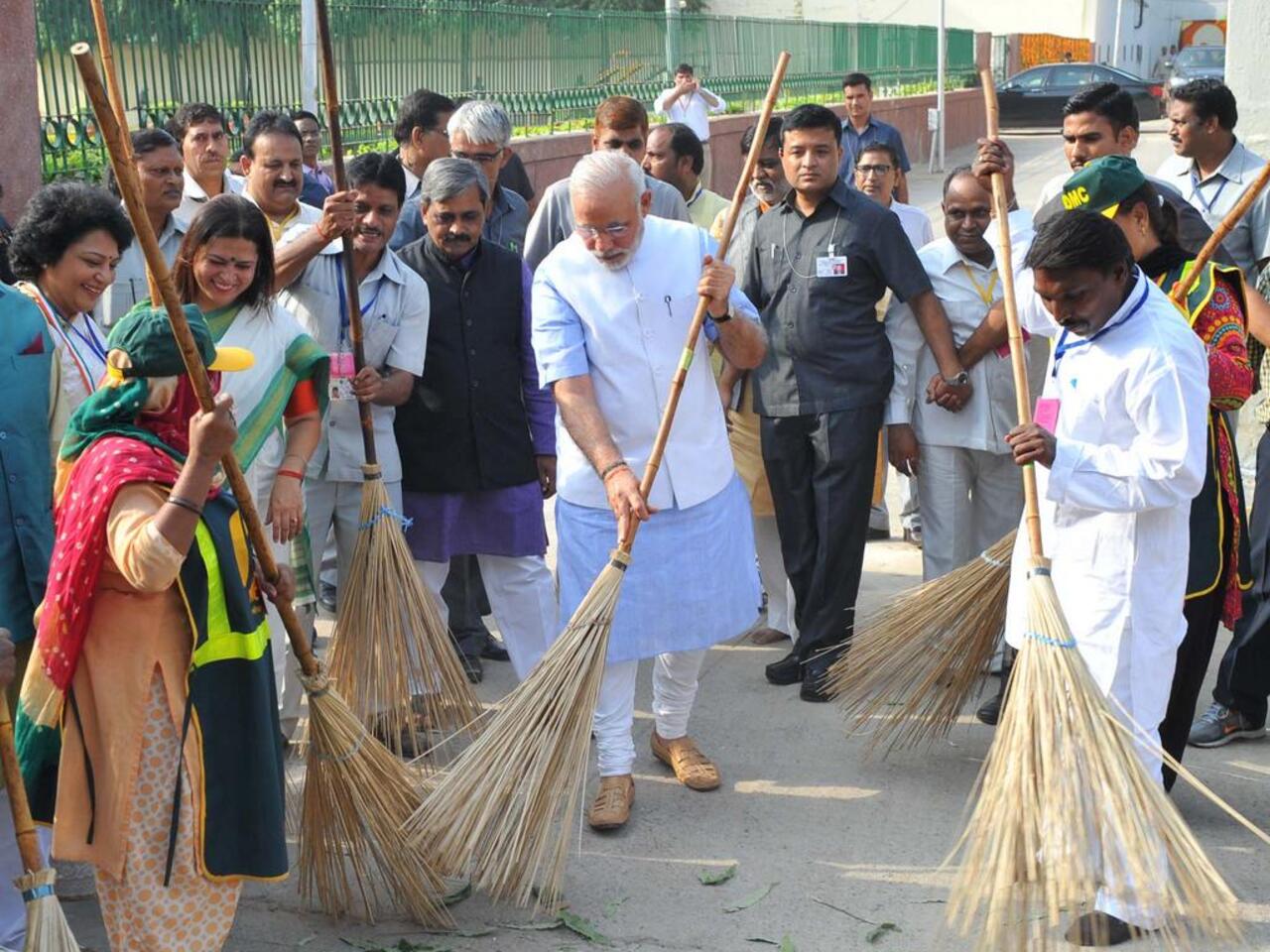
During the past 10 years major improvement in the public water supply and environmental sanitation sector could be seen due to country-wide national flagship programs, namely Swachh Bharat Mission (SBM) 1.0 and SBM 2.0 for both rural and urban, AMRUT 1.0 and AMRUT 2.0 for urban and Jal-Jeevan Mission for rural.
While 60 percent rural populations were practicing open defecation before 2014, with concerted efforts of both state and union governments, all village households have been now provided with toilets in 5 years under SBM program with continuous mobilization of behavioural change initiatives. Improvement in solid and liquid waste management system could be visibly noticed in some urban and rural areas under SBM and AMRUT programs. The Swachh Bharat Mission has claimed to have successfully achieving its goal of making all Indian villages Open Defecation Free (ODF), with all states and Union Territories being declared ODF by October 2019.
However, questions persist
While the Swachh Bharat Mission has declared all villages Open Defecation Free (ODF), implying near-universal access to toilets, a 2017 QCI (Quality Council of India) survey undertaken on behalf of union urban development ministry showed significant variation, with states like Haryana and Himachal Pradesh achieving nearly 100 percent access, while Bihar had 30 percent access. Subsequently, a 2023 study, published in the Journal of Occupational and Environmental Health (JOGH), indicated that large populations in Uttar Pradesh and Bihar still practiced open defecation, suggesting access doesn’t always equate to usage.
Presently the government is committed to supply safe water to every rural household with functional household tap connection (FHTC) through the ‘Har Ghar Jal Yojana’, also known as the Jal Jeevan Mission, with a focus on ensuring the availability of clean, safe, and potable water to all the households through tap connections. This is a critical policy to mitigate arsenic and fluoride problem in the country.
However, there are also question marks about how the plan is getting implemented at ground level. Current situation analysis reflects deficiencies in public water supply systems due to inequity in water distribution, lack of water safety and security, intermittent water supply and post-contamination in pipelines, contamination in spot sources, inadequate disinfection, absence of surveillance mechanism in water supply.
In sanitation sector, though household latrines were constructed, many of such latrines were found to be defective and now requiring retrofitting. In many villages safe distances of water sources from on-site sanitation systems have been compromised. Coverages of Gram-Panchayats with solid and liquid waste management are less and requires thrust with speedy execution to bring benefits to the people. We are yet to treat 50 percent of sewage generating from urban areas of our country resulting in considerable environmental pollution.
Hence, it must be said that though many governmental programs are addressing the improvement in water and environmental sanitation yet considerable population are suffering from various types of water-borne diseases. No doubt, the task is huge but we need to marry policy, program and practice to get a better outcome in the future.
Dr Arunabha Majumder is a professor emeritus at School of Water Resources Engineering, Jadavpur University; and a former director-professor in All India Institute of Hygiene & Public Health, Kolkata.